



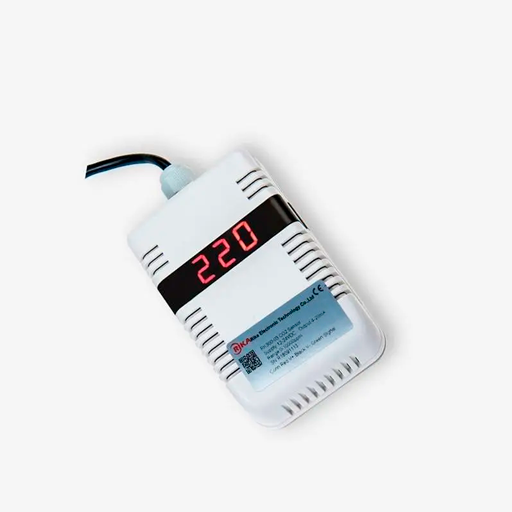
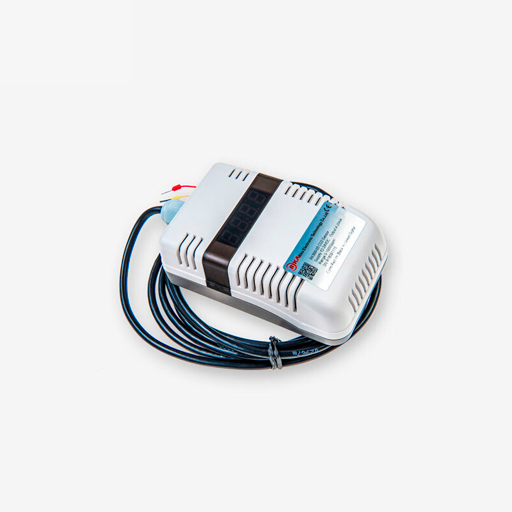
RK300-03 CO₂ Concentration Transmitter Sensor: High-Precision NDIR Air Quality Monitoring
What you should know about this product
- High Sensitivity and Accuracy: NDIR technology that ensures accurate measurements even at low concentrations.
- Temperature Compensation: Built-in automatic adjustment to maintain sensor reliability against thermal changes.
- Long Service Life: Rugged design with no oxygen dependency and high resistance to environmental humidity.
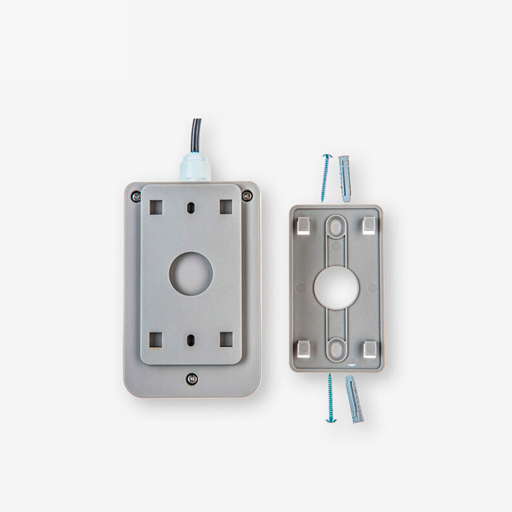
- Installation Versatility: Available in specific models for indoors (wall mount) and outdoors (with protective shield).
- Low Power Consumption: Efficient operation with consumption below 0.25W, ideal for IoT sensor networks.
- Long-Term Stability: Minimal annual drift (<±40ppm), ensuring reliable data year after year.
Product description
The RK300-03 CO₂ transmitter uses the non-dispersive infrared (NDIR) principle to detect the concentration of carbon dioxide in the air with superior sensitivity. This device has been designed with advanced infrared absorption technology, a precise optical path, and high-quality circuits that guarantee fast response and exceptional stability.
To ensure data accuracy, it incorporates an internal temperature sensor that performs automatic compensation based on environmental variations. Unlike other sensors, the RK300-03 does not depend on the presence of oxygen, which, together with its effective resistance to water vapor, gives it a long service life and minimal maintenance. It is available in versions for wall mounting (indoor) or with a radiation shield for demanding outdoor applications.
Technical specifications
- Measurement principle: Non-Dispersive Infrared (NDIR).
- Measurement range: 0-5000 ppm or 0-10000 ppm (depending on model).
- Accuracy: ±50ppm + 2% of reading (@25°C).
- Response time: Less than 20 seconds.
- Warm-up time: 3 minutes.
- Power supply: 5VDC or 12-24VDC.
- Output signals: 4-20mA, 0-5V, 0-10V or RS485 (Modbus).
- Operating temperature: -20 to +60°C (@15-80% RH).
- Housing material: High-strength ABS plastic.
- Certifications: Complies with applicable CE directives.
Recommended uses
- Smart Buildings and Homes: Ventilation (HVAC) control to optimize energy efficiency and occupant health.
- Public Spaces: CO₂ monitoring in hospitals, schools, shopping centers, and offices to ensure safe environments.
- Agriculture (Greenhouses): Precise control of carbon dioxide levels to accelerate crop growth.
- Livestock Industry: Air quality supervision on farms and animal breeding centers.
- Storage: Environmental monitoring in warehouses and logistics centers that require gas control.