



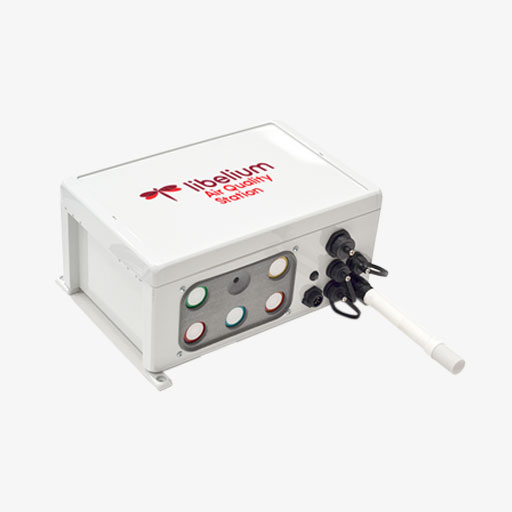
Libelium Smart Cities Station | Air Quality Node for Granular Measurement
What you should know about this product
- Multivariable Monitoring: Simultaneously measures pollutant gases (CO, NO2, O3, SO2), particulate matter (PM1, PM2.5, PM10), and sound levels.
- Scientific-Grade Precision: Calibrated sensors offering granular resolution, ideal for public health studies and regulatory compliance.
- Total Connectivity: Compatible with 4G, LoRaWAN, Sigfox, and WiFi to ensure data transmission from any point in the city.
- Sustainable Power: Integrated solar panel option for total autonomy in remote environmental monitoring deployments.
- Cloud Platform: Native integration with visualization dashboards for real-time pollution and noise heat maps.
Product description
The Libelium Station represents the gold standard for industrial and urban acoustic monitoring, allowing municipalities and companies to transition toward smart management models. Thanks to its modular design, this environmental IoT station enables deploying dense sensor networks that capture pollution variability street by street, something traditional official stations cannot detect.
This device not only works as an advanced real-time sound level meter, but also correlates noise levels with air quality to offer a 360° view of the environment. Its rugged structure is prepared to withstand adverse climates while reporting critical data for decision-making, such as traffic restriction in saturated zones or validation of acoustic barriers. As a highly scalable environmental field sensor, Libelium’s solution transforms conventional cities into healthy and resilient urban ecosystems.
Technical specifications
- Supported Gases: CO, CO2, NO, NO2, O3, SO2, H2S, NH3, among others.
- Particulate Matter: Optical sensor for PM1, PM2.5, and PM10.
- Noise Range: 30 dB to 130 dB (A-weighting).
- Climate Sensors: Temperature, humidity, atmospheric pressure, wind speed, and direction.
- Communication Protocols: LoRaWAN, 4G/5G, Zigbee, WiFi, Sigfox.
- Power Supply: Rechargeable battery with support for solar panel or grid power (110V/220V).
- Housing Protection: IP65 / NEMA 4X (resistant to corrosion and UV rays).
- Local Storage: Internal SD card slot for data backup (Data Logging).
- Data Security: End-to-end encryption (AES-128).
- Calibration: Factory pre-calibrated sensors with field recalibration capability.
Recommended uses
- Smart City Management: Creation of dynamic pollution and noise maps for urban planning.
- Public Health: Air quality surveillance in sensitive areas such as hospitals, schools, and parks.
- Regulatory Compliance: Verification of emission levels in low-emission zones (LEZ) and industrial areas.
- Traffic Management: Analysis of vehicular impact on air quality and environmental noise.
- Environmental Consulting: High-precision tool for audits and environmental impact studies (EIA).